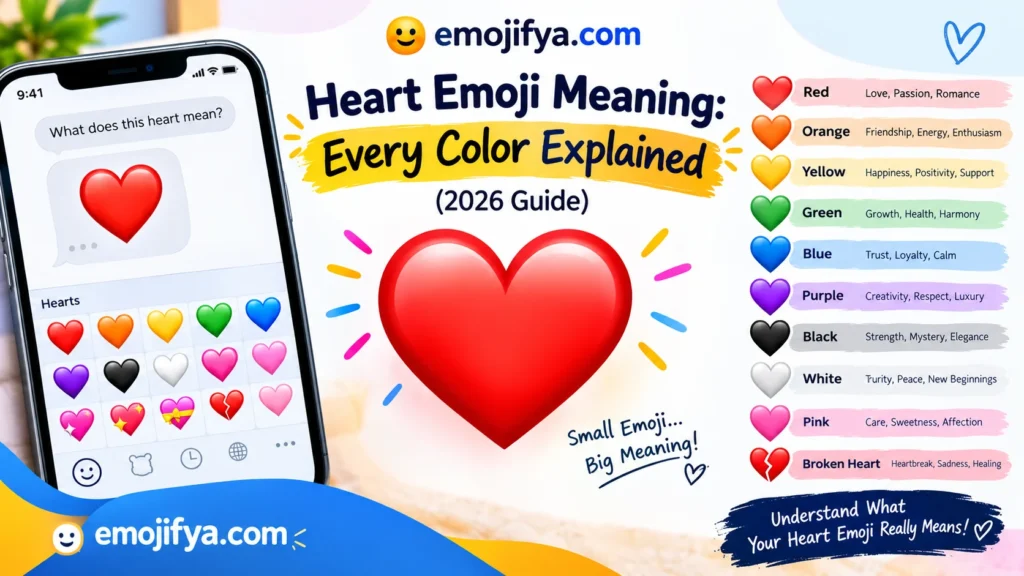
The heart emoji meaning comes down to three things: the color, who sent it, and what else the message says. ❤️ is the strongest heart, used for love or deep affection. 💛, 🧡, 💚 and 💙 usually signal friendship, warmth or support. 🖤 and 💔 lean toward dark humor and sadness. None of this is official. Unicode only gives each heart a name, so the meanings below are habits people have built up over time, and they shift with the relationship and the conversation.
Heart Emoji Meanings at a Glance
| Heart | Usual meaning | How personal it feels |
|---|---|---|
| ❤️ Red | Love, deep affection, heartfelt thanks | Very personal |
| 🩷 Pink | Sweet, gentle affection | Personal, soft |
| 🧡 Orange | Warmth, care, support | Friendly |
| 💛 Yellow | Happiness, friendship, positivity | Friendly, safe |
| 💚 Green | Nature, health, growth, good luck | Neutral |
| 💙 Blue | Trust, loyalty, calm | Friendly, professional-safe |
| 🩵 Light blue | Lighter, playful version of blue | Casual |
| 💜 Purple | Admiration, appreciation, creativity | Warm |
| 🤍 White | Pure or quiet affection, peace, sympathy | Gentle |
| 🤎 Brown | Comfort, coziness | Casual |
| 🩶 Grey | Muted feeling, calm, or just the color | Ambiguous |
| 🖤 Black | Dark humor, grief, edgy style | Depends on the joke |
| 💔 Broken | Heartbreak, disappointment, sympathy | Emotional |
Heart Emoji Meanings by Color
Red heart ❤️
The red heart is the default “I love you.” Between partners it means romantic love. From a parent, sibling or very close friend it means deep affection. It also works as sincere gratitude, as in “Thank you for covering my shift ❤️.”
It isn’t only about people, either. A red heart under a photo of someone’s dinner or a song recommendation usually just means “love this.”
It’s also the heart most likely to be read as romantic when you didn’t mean it that way. If you want warmth without that risk, pick a different color. A simple test: if you’d hesitate to say “love you” to this person out loud, skip the red heart.
Warm hearts: pink, orange and yellow
These are the friendly ones. 💛 is probably the safest heart to send to almost anyone, because it says “I’m happy for you” without hinting at romance. 🧡 is similar and often shows up in encouragement. 🩷 is sweeter and softer, common between friends, relatives and partners.
Pink is a fairly recent addition. The pink, light blue and grey hearts were added in Unicode’s 15.0 emoji update, released in 2022, so an older phone may still show them as an empty box.
Cool hearts: green, blue, light blue and purple
💚 usually points to nature, health or sustainability, and people also send it for luck. Context matters, though: in some online communities green carries other associations. 💙 reads as calm, loyal and trustworthy, which is why brands often use it as a neutral heart. 🩵 is the lighter, more playful cousin.
💜 is more affectionate than blue but less intense than red. Fans use it for artists and groups they admire. In the U.S., purple also recalls the Purple Heart military decoration, so mind the context when service members are involved.
Neutral and dark hearts: black, white, brown and grey
🖤 has the widest range. It can mean sadness or mourning, a dark joke (“Monday again 🖤”), or a liking for gothic or minimalist style. 🤍 feels pure and sincere, and it’s a gentle choice for sympathy. 🤎 is cozy and warm, and it’s also sometimes used in conversations about skin tone and identity. 🩶 is the hardest to pin down: it can be quiet affection, a muted mood, or just someone who likes grey. If one arrives with no other clues, I’d simply ask what it means.
Other Heart Styles and Special Hearts
Shape and decoration change the feeling as much as color does.
| Emoji | What it usually means |
|---|---|
| 💕 Two hearts | Shared affection, sweet and casual |
| 💞 Revolving hearts | Playful, romantic energy |
| 💓 Beating heart | Excitement or nerves |
| 💗 Growing heart | Affection that’s building |
| 💖 Sparkling heart | Delight, celebration, enthusiasm |
| 💘 Heart with arrow | A crush, falling for someone |
| 💝 Heart with ribbon | Gifts, thoughtfulness, gratitude |
| ❣️ Heart exclamation | Emphasis, “I really mean it” |
| 🫶 Heart hands | Support, thanks, shared warmth |
| 🫀 Anatomical heart | The literal organ, or raw intensity |
Broken heart 💔
The broken heart usually means heartbreak, but it’s just as common for disappointment (“They cancelled the concert 💔”) and for sympathy when someone shares bad news. Used lightly, it can be teasing. The words around it almost always settle which one you’re reading.
Heart on fire ❤️🔥 and mending heart ❤️🩹
Both arrived with Emoji 13.1 in 2020. The heart on fire commonly signals passion or intensity, and some people also use it for moving on, as in metaphorically burning a past love. The mending heart suggests healing after hurt. Each is built from two emojis joined together, so older systems may show a heart followed by a separate flame or bandage.
How to Read a Heart You Received
Often the real question isn’t what the emoji means in general. It’s what it means from this person.
| Who sent it | Likely reading | What not to assume |
|---|---|---|
| Someone you’re dating or flirting with | Warm interest, possibly romantic | That it confirms a relationship |
| A close friend | Affection or support, usually 💛 🧡 💙 | Anything romantic |
| Family | Plain love, often ❤️ | Anything beyond care |
| A coworker or manager | Appreciation, often 💙 or 🧡 | Personal closeness |
| Someone you barely know | Politeness or flirting | Either one without more context |
| A brand or support account | Brand-friendly warmth | Any personal feeling |
The most reliable test is comparison. Does this person send hearts to everyone, or is this one unusual for them? A heart from someone who uses them constantly tells you very little. A heart from someone who almost never does tells you more.
Heart Emojis in Real Conversations
These examples are invented illustrations, not real exchanges.
A friend’s celebration
Hira tells her friend she has finally finished her thesis. Ayesha answers with a quick “You did it!! 🩷” The pink heart is affectionate and cheerful, and it’s what close friends send when they’re proud of each other. Nothing romantic is implied.
After a first date
Ella: I had a great time tonight.
Chris: Me too 🧡 Text me when you’re home?
What it means: The orange heart is warm and caring but low pressure, and the practical request adds to that. It suggests interest, but it doesn’t settle where things stand. If Chris had sent ❤️ instead, the tone would be stronger.
Dark humor
Sam complains that it’s only 11 a.m. and he’s already in his fourth meeting. Priya’s whole reply is “Hang in there 🖤”. The black heart is sympathetic and a little ironic, so reading it as grief would miss the joke.
Sympathy, not breakup
Rahul: My flight got cancelled. I’m going to miss the wedding.
Neha: Oh no 💔 I’m so sorry.
What it means: The broken heart here is sympathy for a disappointment. It has nothing to do with a relationship.
Heart Emojis on Snapchat and Other Apps
Snapchat’s friend hearts
On Snapchat, hearts next to a name aren’t expressions of feeling. They’re status labels the app assigns:
- 💛 Yellow heart: You and that person are each other’s number one best friends.
- ❤️ Red heart: You’ve held that number one spot with each other for two weeks in a row.
- 💕 Pink hearts: You’ve held it for two months in a row.
They have nothing to do with romance, and only one friend can have them at a time. Snapchat also lets you swap the default friend emojis for others in its settings, so don’t treat what you see as universal. The app can also change these labels over time, so check yours if it looks different.
Hearts as reactions
On Instagram, WhatsApp, iMessage and similar apps, a red heart is often a one-tap “like” reaction. It means “I saw this and liked it,” which carries less weight than a heart someone chose to type into a message.
Keep the two apart. A heart reaction is a quick acknowledgement, while a heart typed into a message is a deliberate choice. Reading a one-tap reaction as a declaration of feeling is one of the easiest ways to misread someone.
Why Heart Meanings Change (and How They Get Misread)
Four things shift a heart’s meaning more than the emoji itself:
- The relationship. A 💛 from your best friend feels different from a 💛 from a coworker or a new match.
- The words around it. “Can’t wait to see you ❤️” and “Thanks for the update ❤️” carry very different weight.
- Color as affinity. Colored hearts often show support for something of that color: a team, a flag, a cause, a brand.
- Personal habits. Some people put hearts on everything. Others rarely use them.
Most misreadings come from three assumptions. People assume each color has one official meaning (only the names and codes are official), that a red heart always means romance (plenty of people use it as a warm sign-off), and that only the sender’s intent counts (the reader’s interpretation matters too).
Design also plays a part. The same heart looks slightly different on iPhone, Android and Windows, which can change how warm or playful it feels.
How to Choose the Right Heart
| Situation | Safer choice | Why |
|---|---|---|
| Thanking a coworker | 💙 or 🧡 | Warm without being personal |
| Congratulating a friend | 💛 or 💖 | Celebratory and platonic |
| Saying you love someone | ❤️ or 💞 | Clearly affectionate |
| Comforting someone | 🤍 or 🫶 | Gentle and sincere |
| Supporting a team or cause | The matching color | Color affinity is widely understood |
| Messaging someone you don’t know well | A smiley, or no emoji | Hearts can imply more closeness than you mean |
| Not sure how it will land | A softer heart plus clear words | Words remove the guesswork |
A quick check before sending: if the other person screenshotted this, could it be read in a way you didn’t intend? If so, soften the heart or add a few words.
A Cultural and Legal Note on the Red Heart
In some places, a red heart sent to someone who doesn’t welcome it can be treated as harassment. In 2022, Gulf News reported a Saudi cybercrime expert warning that red hearts and similar emojis with romantic connotations, sent without consent, could fall under the country’s anti-harassment rules if the recipient files a complaint. That was one expert’s interpretation as reported in the news, not a court ruling, and outcomes depend on the facts of each case. The practical takeaway is simple: avoid sending romantic emojis to anyone who hasn’t shown they want them.
Frequently Asked Questions
What does a red heart mean from a guy or a girl?
There’s no universal answer. Between friends or family it’s usually warm affection. Between people who are dating or flirting, it may be romantic. Look at the full message and at how that person normally writes.
What does the yellow heart mean?
Most often friendship, happiness and positivity. On Snapchat it has a separate, app-specific meaning (see above).
What does the black heart mean?
Sadness, dark humor, or a taste for a dark, sleek style. The surrounding message tells you which.
What does the white heart mean?
Usually pure or calm affection, peace, or quiet sympathy.
What does the grey heart mean?
It has no settled meaning yet. It can suggest muted or restrained feelings, calm, or simple liking for the color. Check the context.
Why do I see a box instead of a heart?
Newer emojis like the pink, light blue and grey hearts may show as empty boxes on older operating systems. Updating your device usually fixes it.
Is ❤️ the same as ♥️?
No. ♥️ is the playing-card heart suit and can look flatter or plainer than ❤️, depending on the device.
Which heart is safest to send?
💛 and 💙 are among the most neutral. Either gives a warm tone without implying romance.
Is a heart emoji flirting?
Only sometimes. A red or pink heart can be flirty when the rest of the conversation is, but plenty of people send them to friends and family. The pattern matters more than any single heart.
Should I reply to a heart with a heart?
Usually it’s fine to mirror the same level of warmth. If you want to stay friendly without raising the stakes, reply with a softer heart or a few words instead.
Is it unprofessional to send a heart at work?
It depends on the workplace. In many teams a 💙 or 🧡 after a thank-you is normal. If you’re writing to a client or someone senior you don’t know well, words alone are the safer choice.
The Short Version
Color gives you a starting point, and the relationship and wording give you the actual meaning. When you send a heart, pick the one that matches how close you really are. When you receive one, treat it as a clue rather than proof, and compare it to how that person usually writes.

Shahzad is a content creator passionate about emoji meanings, digital communication, and online expressions. He enjoys exploring the meanings behind popular emojis, their symbolism, and how people use them in everyday conversations. Through Emojifya, he aims to help readers understand emojis and express themselves confidently. 😊