The 😍 emoji means love, adoration, or being completely taken with something. It’s a smiling face with hearts for eyes, and it says “I love this!” or “I’m obsessed!” What’s being loved can be a person, a photo, a plate of food, a puppy, or a plan.
Here’s what most people really want to know: a 😍 is not automatically a romantic message. Usually it’s just enthusiasm. Whether it means more depends on who sent it, what it’s replying to, and what else the message says.
😍 at a Glance
| Question | Short answer |
|---|---|
| What does it mean? | Love, adoration, infatuation, strong delight |
| Is it romantic? | Sometimes. Often it’s just excitement |
| Official name | Smiling Face with Heart-Eyes (first approved as “Smiling Face with Heart-Shaped Eyes”) |
| Code point and shortcode | U+1F60D, :heart_eyes: |
| Softer alternative | 🥰 |
| “Wow” alternative | 🤩 |
| Cat version | 😻 |
| Fine at work? | In casual chat, yes. In formal emails, skip it |
| Biggest mistake | Reading it as a love confession, or sending it in a serious moment |
What 😍 Means in Everyday Use
When you love how something looks
This is the most common use. Someone posts a sunset, a fresh haircut, a bowl of biryani, or a baby photo, and 😍 stands in for “that’s gorgeous.” It’s also the quickest way to say “I want that” about shoes, cars, and gadgets. (Food counts too. Food counts a lot.)
When you’re excited about news or plans
Heart-eyes can also mean “I can’t wait.” If a friend says they’ve booked a trip to the mountains and you answer “Count me in 😍,” you’re not in love with the trip. You’re thrilled about it.
When you feel affection for a person
Between partners, or when two people are flirting, 😍 can carry real romantic feeling. Between friends and relatives it’s usually a warm “I adore you,” like a reaction to a kind gesture or a great photo of someone.
Is 😍 Romantic? How to Tell
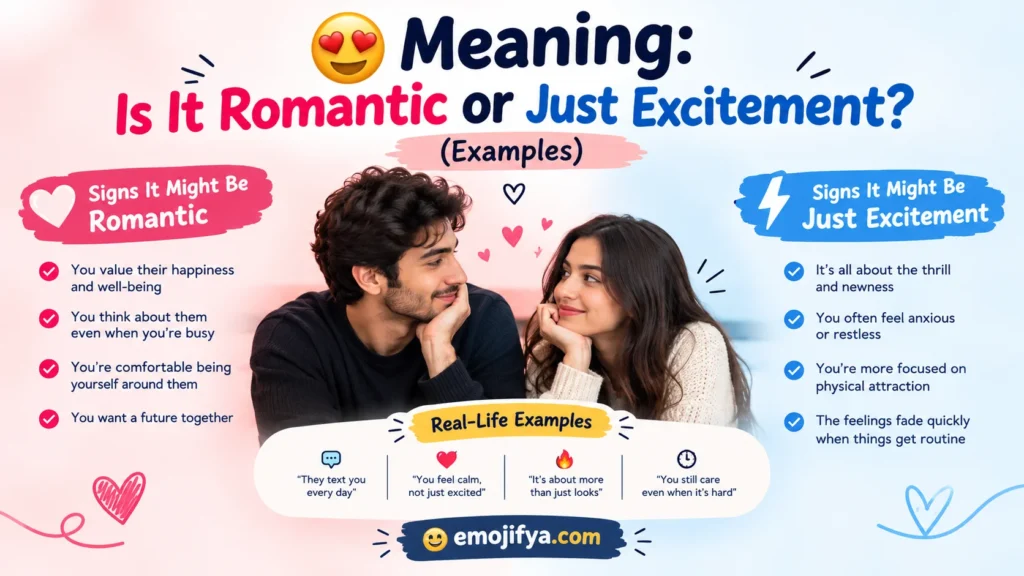
No single emoji can settle this, but a few clues get you most of the way.
Signs it leans romantic
- It replies to a personal compliment, a selfie, or something intimate.
- The sender rarely uses it, then uses it with you.
- The wording around it is flirty, or the chat was already heading that way.
- It shows up in late-night, one-on-one messages with “thinking of you” type lines.
Signs it’s just friendly
- It’s reacting to an object, a pet, food, or a place.
- The sender uses 😍 on everything and everyone.
- It appears in a group chat or a public comment.
- The rest of the message is casual or practical.
Honestly, the sender’s usual style tells you more than the emoji does. Someone who sprinkles 😍 on every post is just expressive. Someone who almost never uses it and then sends it to you is giving you a slightly stronger signal.
What one emoji can’t tell you. A 😍 doesn’t prove someone is in love with you, and it doesn’t prove they aren’t. If the answer matters to you, a kind, direct conversation beats emoji detective work every time.
Real-Life Examples
The scenes below are invented, but they’re the kind of moments where 😍 shows up. Notice how little the emoji changes and how much everything around it does.
Example 1: Pure delight
Ayesha: Just adopted this little guy. [photo of a kitten]
Zara: 😍😍 What’s his name?!
What it means: The emoji is about the kitten. Doubling it and asking a follow-up question reads as excitement, not romance.
Example 2: Possibly affectionate
Daniel: I saved you a seat at the café. Your usual latte is on its way.
Priya: You remembered 😍
What it means: The emoji answers a thoughtful, personal gesture, so it leans warm. Whether it’s romantic depends on what Daniel and Priya are to each other, and the message alone doesn’t settle that.
Example 3: Workplace
Chloe: The client loved the new logo options.
Marcus: Amazing news 😍
Marcus is just celebrating the result. That’s normal in a casual team chat, though in a formal email to the client itself, a plain sentence would be the safer choice.
Example 4: Family
Hamza: Mom, look at the cake I made for Bilal’s birthday. [photo]
Mom: 😍 So beautiful! Save me a slice.
No romance here, just a proud mom. Family chats are probably where 😍 is least likely to be misread.
Example 5: Public comment vs. private message
Imagine someone comments 😍 under your vacation photo. Now imagine the same person sends 😍 alone, in a private chat, right after you say you’re feeling a bit down. The emoji is identical, but the first is praise for a photo and the second might not fit the moment at all.
What it means: Where and when an emoji appears matters as much as the emoji itself. A public reaction is usually casual. A private one is more personal, and a mismatch with the mood of the chat can feel off.
Example 6: A tone twist
Nora: The meeting got moved to 7 a.m. tomorrow.
Leo: Oh great, my favorite 😍
What it means: Leo’s words are sarcastic, and the emoji follows his tone. This is an occasional, informal use, and it only works because the sentence around it signals the joke. By itself, 😍 doesn’t mean sarcasm.
How the Words Around 😍 Change Its Meaning
The same emoji can read differently depending on what sits next to it. These are common patterns, not rules, but they’re a useful starting point.
| Pattern | How it usually reads | Example |
|---|---|---|
| 😍 on its own | Quick, general delight. Easy to misread because there’s no context | 😍 |
| A compliment + 😍 | Admiration for how someone looks or what they did | “You look amazing 😍” |
| A plan + 😍 | Excitement and anticipation | “Can’t wait for Friday 😍” |
| “Thanks” + 😍 | Warm gratitude | “Thanks for the gift 😍” |
| 😍 + ❤️ or 😘 | More affectionate, often more personal | “Miss you 😍❤️” |
| Several 😍 in a row | Playful, over-the-top enthusiasm | “That dress 😍😍😍” |
| Negative words + 😍 | Often a joke or sarcasm | “7 a.m. meeting, great 😍” |
The takeaway: if you want your meaning to land the way you intend, put a few words next to the emoji. “That cake looks incredible 😍” can’t be mistaken for much else. A lone 😍 can.
How to Reply to a 😍
Think about who you’re talking to, then match their energy. Here’s a simple way to handle the common cases.
| Situation | A good reply |
|---|---|
| They’re reacting to something you shared | Thank them, or add a detail: “Thanks! It took forever to bake.” |
| It feels friendly | 😊, 🥰, or “That made my day” |
| You think it’s romantic and you feel the same | ❤️, 😘, or a warm personal line |
| You think it’s romantic and you don’t feel the same | Stay kind and clear. Don’t answer feelings nobody has actually stated |
| You can’t tell | Ask lightly: “What are you loving about it?” |
Should You Send 😍? A 10-Second Check
Most guides only explain what the emoji means when you receive it. If you’re the one about to send it, ask yourself three things:
- Is this really about the thing, or about the person? If it’s about a photo or a plan, you’re safe. If it’s about a person you don’t know well, think about how it might land.
- Is this the right place? A casual chat or a public comment is low risk. A message to a client, a manager, or someone you’ve just met is higher risk.
- Could a few words do the job better? “You look amazing 😍” is clearer than 😍 alone, because the words tell the reader what you’re reacting to.
If any answer makes you hesitate, swap in 🥰 or 😊, or just write the sentence. And don’t overdo it: one or two heart-eyes usually feels warm, while a long row can read as joking or over the top.
Mistakes That Make 😍 Backfire
Most of the time 😍 is harmless. These are the situations where it can go wrong.
- Reacting to serious or sad news. If someone shares a loss, a diagnosis, or a bad day, 😍 will almost always feel tone-deaf. Choose a caring sentence instead.
- Sending it to someone you barely know. It can read as flirting, even if you meant it as friendly.
- Using it in a formal setting. A client email, a job application, or a message to a senior colleague is better off without it.
- Using it to dodge a real conversation. If someone asks “how do you feel about me?” and you answer with 😍, you’ve given them a puzzle, not an answer.
- Overdoing it. A whole row of heart-eyes can look insincere, especially in a serious chat.
😍 vs. 🥰, 🤩, 😘, ❤️ and 😻
These emojis overlap, but each has its own shade.
| Emoji | Usual feeling | How it differs from 😍 |
|---|---|---|
| 🥰 | Warm, cozy affection; feeling cherished | Softer and calmer. 😍 is more excited and wide-eyed |
| 🤩 | Amazement, “wow,” being starstruck | About being impressed, not about loving something |
| 😘 | A kiss, flirting, affection toward a person | More directed at someone, and often more flirtatious |
| ❤️ | Love in a steadier, more lasting sense | In private messages it can feel more intimate than 😍 |
| 😊 | Gentle happiness | No infatuation at all |
| 😻 | Heart-eyes, cat style | Playful, often used for pets and cute things |
Rule of thumb: if you want to say “I adore this” without any romantic edge, go with 🥰 or 😊. If you’re impressed rather than smitten, 🤩 fits better. If you want to show maximum excitement, 😍 is hard to beat. Emojipedia’s editors have noted that 😍 and 😘 can both read as romantic, which is why some people hesitate to send them to friends or family.
Where 😍 Fits and Where to Be Careful
- Public comments and group chats: Fine. It’s one of the most natural reactions to photos and posts.
- Private messages: More personal. Read the mood of the conversation first.
- Friends and family: Fine. Most people read it as warmth.
- Dating or flirting: It can add a spark, but it’s easy to overread, so pair it with clear words.
- Workplace: Fine in casual chat with colleagues you know. Avoid it in formal emails or with someone who might misread it.
- Brands and reviews: Businesses use it to signal that something is loved, and some rating prompts use it in place of “extremely satisfied.”
Common Misunderstandings
The biggest mix-up is treating 😍 as a love confession. Most of the time it’s about a thing, not a person, and even when it’s about a person it often means “I think you’re great” rather than “I’m in love with you.” If someone sends it to you, it’s possible they like you, but that’s a guess, not proof.
Another one is assuming the emoji looks the same everywhere. It doesn’t. Each platform draws its own version, so the face and hearts differ a little on Apple, Google, Samsung, and Windows, even though the idea stays the same.
People also read too much into repetition. Three heart-eyes under a cat photo mean “so cute,” not “stronger feelings than one.” And finally, tone varies by age group, community, and culture. The core meaning is widely understood, but how a particular person uses it is personal.
Where 😍 Comes From
Unicode, the standard that defines emoji, approved the character in 2010 as part of Unicode 6.0, and it joined the official emoji set in 2015. Its original name was “Smiling Face with Heart-Shaped Eyes,” later shortened to “Smiling Face with Heart-Eyes.” The oversized hearts and wide mouth resemble heart-eyes in manga and anime, which helps explain its exaggerated, “gaga” feel.
The cat version, 😻, has an older backstory. It first appeared on early Japanese emoji keyboards in 2003, before Unicode standardized emoji.
Why it looks different on your phone
Unicode defines the character, not the artwork. Apple, Google, Samsung, Microsoft, and social apps each design their own version. That’s why a 😍 you send from an iPhone can look a little different when it lands on an Android phone or in WhatsApp. If a message reads oddly, that’s often the reason.
How to type it
- Phone: Open the emoji keyboard and search “heart eyes.”
- Windows: Press Windows key + period (.) and search.
- Mac: Press Control + Command + Space and search.
- Apps that support shortcodes: Type
:heart_eyes:.
Frequently Asked Questions
What does 😍 mean from a girl or a guy?
The emoji has no gender-specific meaning. It shows delight or affection, and what the person intends depends on your relationship and the conversation.
Is 😍 flirty?
It can be, especially when it replies to a compliment, a selfie, or a personal gesture. In many other situations it’s simply enthusiasm.
What’s the difference between 😍 and 🥰?
😍 is more excited and infatuated. 🥰 is softer, closer to feeling warm and cared for.
What can I send instead of 😍?
Use 🥰 for warmth, 🤩 for amazement, ❤️ for deeper love, or 😊 for something friendly and low-key.
How many 😍 should I send?
One or two is usually enough. A long row can feel like a joke or too much, depending on who you’re talking to.
What does 😻 mean?
It’s the cat version: a smiling cat with heart-eyes. It carries the same affection, often aimed at pets or anything adorable.
Why does 😍 look different on my phone?
Each platform designs its own emoji artwork, so the same character looks a little different from one platform to the next.
Can I use 😍 in a professional message?
In a casual chat with colleagues, usually yes. In a formal email, a client message, or a first message to someone you don’t know well, a plain sentence is the safer choice.
The Bottom Line
So, what does 😍 mean? Love, delight, or “wow, I really like this,” aimed at a person, an object, or an idea. What it doesn’t mean, on its own, is “I’m in love with you.”
Before you read too much into one, check what it’s replying to, who sent it, where it appeared, and what words came with it. Before you send one, ask whether a few words would make your meaning clearer. And if the feeling behind a 😍 really matters, skip the guessing and ask.
DISCOVER MORE ARTICLES
Meaning: Relief, Tired or Annoyed? How to Tell + Reply
Heart Emoji Meaning: Every Color Explained (2026 Guide)

Shahzad is a content creator passionate about emoji meanings, digital communication, and online expressions. He enjoys exploring the meanings behind popular emojis, their symbolism, and how people use them in everyday conversations. Through Emojifya, he aims to help readers understand emojis and express themselves confidently. 😊